
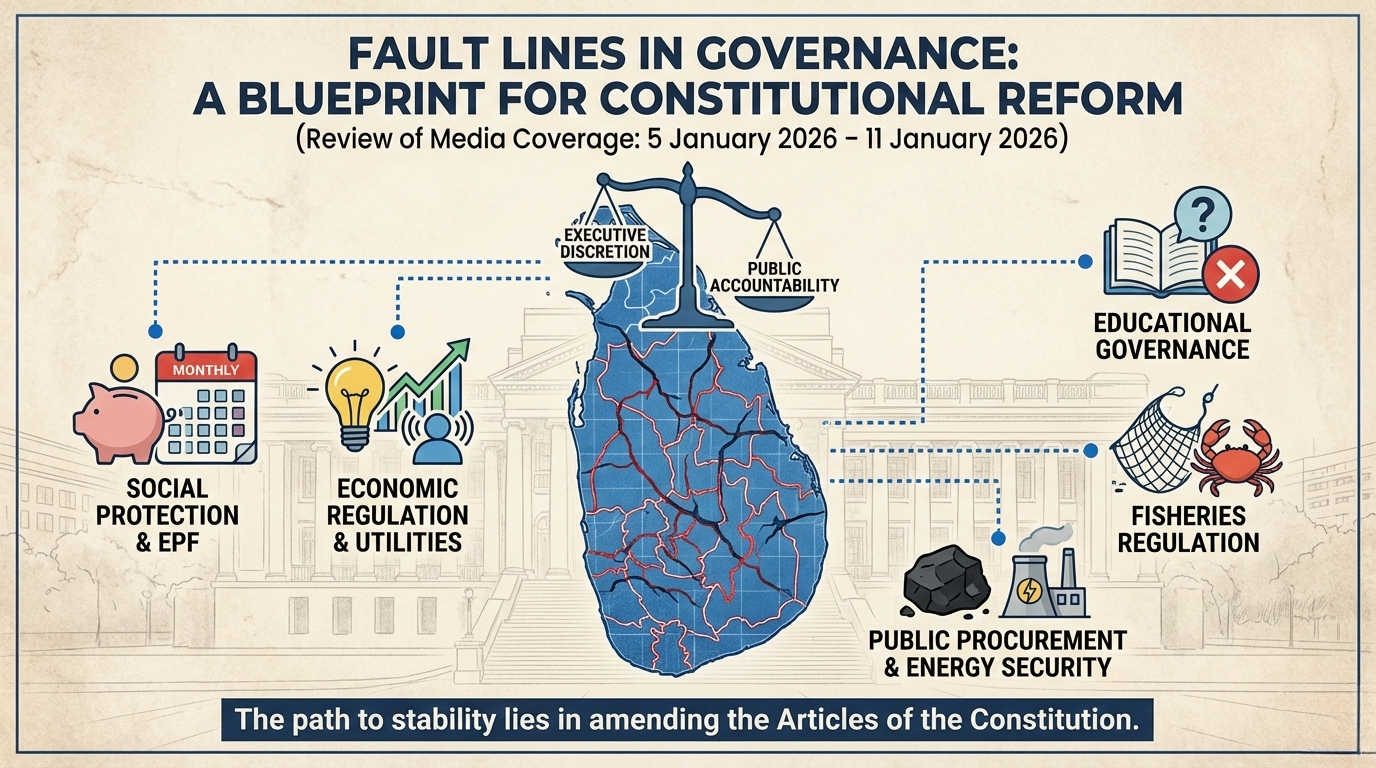
Fault Lines in Governance
A Blueprint for Constitutional Reform
(Review of Media Coverage: 5 January 2026 – 11 January 2026)
The media coverage during the week from 5 January 2026 to 11 January 2026 reveals a constitutional order struggling to balance executive discretion with public accountability. The following analysis examines how existing articles of the 1978 Constitution are being tested and where the ‘Supreme Law’ requires urgent amendment to protect the citizenry.
1. Social Protection and Fiduciary Duty
One of the key concerns raised during the week relates to social protection and the governance of workers’ funds, following media reports that the Government is considering a mechanism to convert Employees’ Provident Fund (EPF) savings from lump-sum withdrawals into monthly pension-style payments. Reports also indicate ongoing efforts to resolve documentation issues connected to the second 30% EPF withdrawal, although discussions on a final disbursement model remain ongoing. These proposals carry significant constitutional implications, as EPF contributions constitute workers’ private earnings held by the State in a fiduciary capacity. Altering the mode of disbursement challenges workers’ legitimate expectations of access to their savings and engages implied property interests, notwithstanding the absence of an explicit right to property within Sri Lanka’s Fundamental Rights chapter. Any reform to EPF disbursement must therefore comply with Article 12(1) of the Constitution by ensuring equality, non-discrimination, transparency, and procedural fairness across all categories of workers. In its role as trustee, the State is constitutionally obliged to act in the best interests of contributors, requiring informed consent, strong governance safeguards, and protections against arbitrary executive interference in the management of private contributory funds.
2. Economic Regulation and Public Utilities
Another major concern raised during the week relates to economic regulation and the governance of public utilities, following a proposal by the Ceylon Electricity Board (CEB) to impose an average electricity tariff increase of 11.57% for the first quarter of 2026. The increase has been justified on the basis of costs arising from Voluntary Retirement Scheme payments, storm-related losses following Cyclone Ditwah, and debt servicing obligations. While public oral hearings have been scheduled and officials have reiterated that tariff reductions remain a long-term objective, the proposal raises significant constitutional concerns relating to procedural fairness, transparency, and meaningful public participation in economic regulation. Tariff-setting decisions engage Article 148 of the Constitution, which vests Parliament with full control over public finance, yet, in practice, the delegation of regulatory authority to the Public Utilities Commission of Sri Lanka (PUCSL) often occurs with limited substantive parliamentary scrutiny. Passing restructuring costs or extraordinary financial burdens onto consumers therefore raises broader questions of fiscal accountability, regulatory oversight, and the constitutional legitimacy of public utility governance. This episode reflects the need for reasoned, transparent, and participatory decision-making processes that align regulatory discretion with democratic and legislative accountability.
3. Educational Governance and Ministerial Accountability
The controversy arising from a reference to an inappropriate website in a Grade 6 English textbook produced by the National Institute of Education brought issues of ministerial accountability and administrative oversight into sharp focus during the week. Opposition calls for the resignation of the Prime Minister and the Minister of Education, Harini Amarasuriya, were met with firm denials of political involvement, alongside assurances that the material had been intercepted before reaching students and that internal investigations had been initiated. This episode nevertheless exposes deeper institutional weaknesses within public education governance, particularly with regard to quality-control mechanisms and internal accountability structures. From a constitutional perspective, the incident highlights the persistent ambiguity surrounding political responsibility under Sri Lanka’s constitutional framework. Article 42 establishes that the Cabinet of Ministers is collectively responsible and answerable to Parliament, yet in practice ministers frequently distance themselves from administrative failures by attributing blame to bureaucratic processes. While not every administrative lapse warrants ministerial resignation, systemic failures within state institutions fall squarely within the domain of executive oversight. At the same time, any resort to criminal investigative mechanisms must remain proportionate, ensuring that governance failures are addressed through appropriate accountability measures without normalising punitive responses in essentially administrative contexts.
4. Fisheries Regulation and Social Security
Recent regulatory developments in the fisheries sector, including new measures to protect mud crab stocks through minimum size limits and periodic scientific review, reflect an effort to align environmental conservation objectives with international export standards. At the same time, the approval of a redesigned contributory pension and social security scheme for fishers signal a policy commitment to strengthening livelihood protection within a particularly vulnerable sector. Constitutionally, these interventions underscore the central role of delegated legislation in mediating between competing public interests such as environmental sustainability, economic activity, and social security. While Article 76 of the Constitution permits Parliament to delegate legislative authority to the executive, it also prohibits the abdication of legislative power, thereby necessitating robust oversight of subordinate legislation. The impact of these regulations on livelihoods and access to social protection reinforces the importance of transparency, meaningful stakeholder consultation, and effective parliamentary scrutiny when delegated legislation directly affects the socio-economic rights of vulnerable communities.
5. Public Procurement and Energy Security
Concerns relating to procurement integrity and operational risk in the energy sector were raised following allegations regarding the supply of substandard coal to the Lakvijaya (Norochcholai) power plant. This incident highlights serious weaknesses in the oversight of critical public infrastructure and engages core constitutional principles of public finance accountability, procurement transparency, and energy security. Under the existing constitutional framework, the Auditor General’s powers under Article 154 are largely confined to post-facto reporting, often after financial loss or operational damage has already occurred. The absence of mechanisms for proactive intervention in high-value or high-risk procurement processes exposes systemic vulnerabilities in public sector contracting. This episode reflects the need for stronger procurement safeguards, more effective audit oversight, and enhanced accountability structures, particularly in sectors where procurement failures can have significant fiscal, economic, and public welfare consequences.
Conclusion
The second week of January 2026 illustrates that Sri Lanka's 1978 Constitution is too top-heavy, favouring executive discretion over institutional safeguards. The path to stability lies not just in changing personnel, but in amending the Articles of the Constitution to shift power back to the people through mandatory consultation, transparent procurement, and strictly defined ministerial duties.

Comments (0)
Sign in to leave a comment
No comments yet. Be the first to comment!