
The Fragility of the Framework
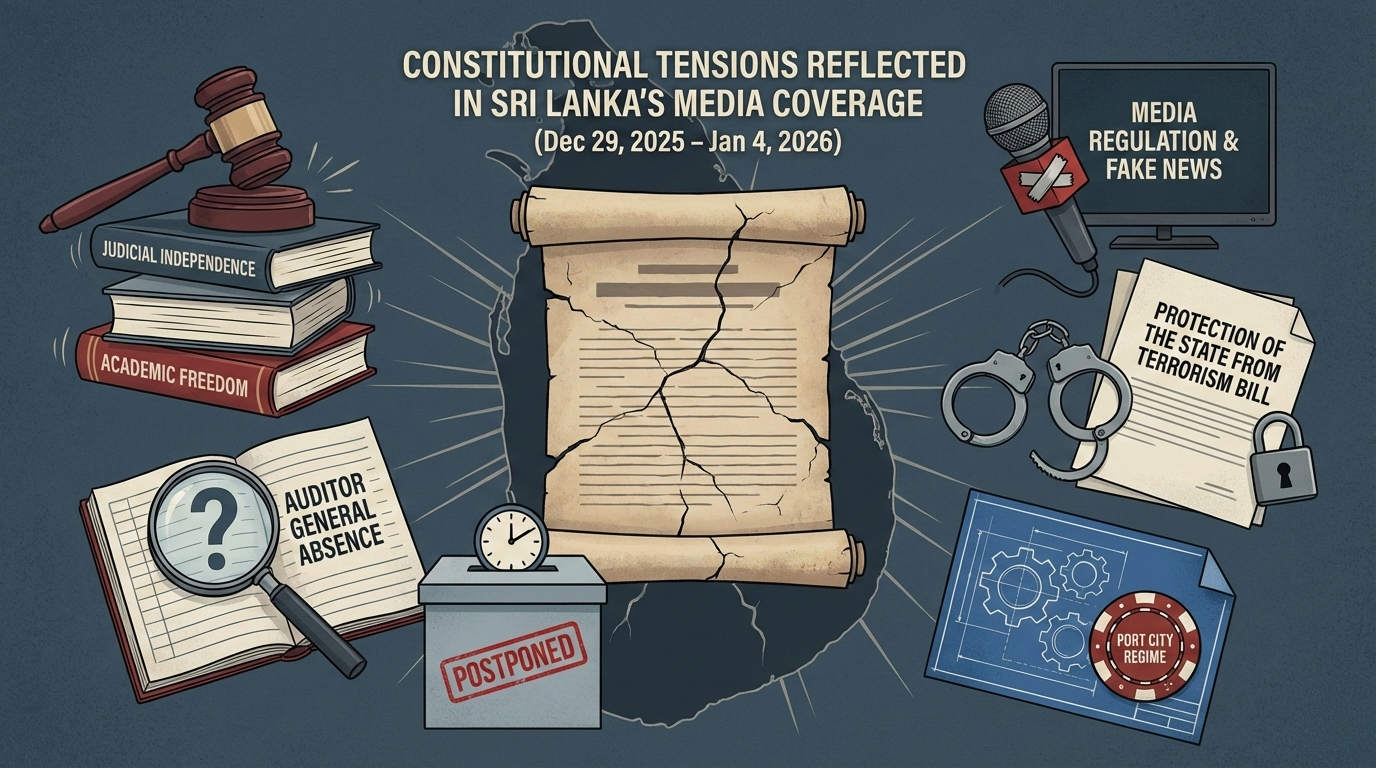
Constitutional Tensions Reflected in Sri Lanka’s Media Coverage
(Review of Meida Coverage: 29 December 2025 – 4 January 2026)
The transition into 2026 has been marked by a series of legal and institutional limitations that suggest a deepening constitutional crisis. The media coverage during the first week of the year reflects persistent structural tensions within Sri Lanka’s constitutional framework. From the paralysis of oversight bodies to the erosion of judicial and academic independence, this article outlines the primary battlegrounds for the rule of law in Sri Lanka today.
1. The Erosion of Institutional Oversight
One significant institutional concern during this period has been the continued absence of a permanent Auditor General, raising serious questions about constitutional governance, institutional independence, and the effectiveness of the country’s accountability architecture. Following the retirement of Chulantha Wickramaratne in April 2025, several individuals proposed by the President were reportedly rejected by the Constitutional Council, as the Constitution requires presidential appointments to this office to receive Council consent. This prolonged impasse reflects a breakdown in the system of checks and balances envisioned under the current constitutional framework, leaving the nation’s primary financial watchdog in a state of prolonged ‘acting’ limbo. Consequently, an Acting Auditor General has been in office for nearly three months, a situation that undermines the security of tenure necessary for robust financial oversight. The reliance on an acting official weakens the office’s capacity to independently scrutinise executive fiscal decisions, particularly in relation to emergency expenditures. This delay has directly affected the timely examination of public spending linked to Cyclone Ditwah relief efforts, thereby diminishing the effectiveness of constitutionally mandated mechanisms of fiscal accountability.
2. The Democratic Deficit: Devolution and Representation
Another persistent issue that has remained evident over several years is the continued postponement of Provincial Council elections, largely resulting from repeated attempts to amend the electoral system. As a consequence, Provincial Councils have not been reconstituted through democratic elections, resulting in administrative arrangements and associated governance costs to continue without elected oversight. This prolonged delay reflects serious limitations in democratic representation and the functioning of devolution in Sri Lanka. By failing to restore elected provincial bodies, the state arguably breaches the constitutional right to political participation and creates a sustained democratic deficit within a devolved system of government. Moreover, the absence of elected subnational representation has produced an administrative vacuum in which provincial governance is exercised by unelected officials, effectively centralising authority and undermining the spirit and intent of the 13th Amendment. The continued non-functioning of Provincial Councils therefore raises justiciable concerns regarding both the erosion of constitutionally recognised subnational representation and the effective operation of devolution.
3. Judicial Independence and Executive Incursion
Another significant concern raised during the week relates to judicial independence, following recent judicial promotions that departed from the established principle of seniority without the articulation of clear, transparent, or publicly available merit-based criteria. The Bar Association of Sri Lanka (BASL) formally conveyed its concerns to the President, warning that such departures risk undermining both judicial independence and public confidence in the administration of justice. Judicial promotions conducted in the absence of objective and transparent standards expose the judiciary to actual or perceived executive influence, particularly where discretionary power is exercised by the executive branch. This practice raises serious questions regarding the constitutional principle of separation of powers and risks fostering a perception of a compliant judiciary. Ultimately, the erosion of transparent appointment processes threatens the perceived impartiality of the courts, which function as the final institutional safeguard for citizens against state overreach and are essential to maintaining public trust in the justice system.
4. Academic Freedom vs. Political Control
Another significant issue raised during the week concerns academic freedom and institutional autonomy, following the Cabinet’s approval of amendments to the Universities Act that permit the summary removal of Deans and Heads of Departments by University Councils prior to the completion of their terms, without clearly defined statutory grounds. Objections to this amendment have been raised on the basis that University Councils are largely composed of government appointees and that the reform was introduced with limited consultation with academic stakeholders. In this context, the provision for summary removal substantially heightens the risk of politicisation within universities by enabling enhanced executive influence over academic governance. From a constitutional perspective, this increased political control directly implicates academic freedom, institutional autonomy, and freedom of expression within higher education institutions, while also raising serious concerns regarding fairness, independence, and due process in academic administration. By weakening institutional safeguards, the amendment risks the freedom of expression and the autonomy of academic institutions, turning centres of learning into extensions of political administration.
5. Media Regulation and Indirect Censorship
Freedom of expression and media regulation emerged as another area of concern during the week, following a public statement by a government minister who explicitly named a private television channel and suggested the possible cancellation of its broadcasting licence for the dissemination of ‘fake news.’ This incident reflects a significant structural flaw in Sri Lanka’s media regulatory framework, namely the continued absence of an independent broadcasting authority. At present, broadcasting licences remain under the control of the Ministry, frequency allocation is managed by the Telecommunications Regulatory Commission, and private broadcasting licences are issued on a temporary basis. Such an executive-controlled licensing regime, operating without independent regulatory oversight or robust procedural safeguards, poses serious risks to media independence and freedom of expression. In this context, content-based threats to licence revocation amount to a form of indirect censorship and prior restraint, where the possibility of executive sanction can be used to silence or deter critical reporting, thereby raising grave constitutional concerns.
6. National Security and Fundamental Rights
In relation to security legislation and fundamental rights, media reports during the week indicated that the Government has advanced a draft titled the ‘Protection of the State from Terrorism Bill’, intended to replace or substantially amend the Prevention of Terrorism Act (PTA), in response to longstanding concerns raised by the United Nations Human Rights Council. The proposed bill reportedly introduces narrower definitions of terrorism, limits on detention, strengthened access to legal counsel, and enhanced judicial oversight. The degree of power granted for pre-trial detention remains a concern for due process. The constitutionality of this bill rests on whether it can truly reconcile national security with the fundamental rights of liberty and expression.
7. Economic Governance: The Port City Paradigm
In relation to economic governance and special regulatory regimes, policy adjustments for the Port City Regime were made. The adjustments include new ‘Business of Strategic Importance’ classifications and issuance of casino licences. This reflects a shift in fiscal policy. In order to maintain constitutional equality, it should be seen that special economic zones are operated within the bounds of legal certainty. Differential tax treatments and regulatory exemptions must be balanced against the principle of equality before the law to ensure that the Port City does not become a constitutional ‘state within the state.’
Conclusion
The events of early 2026 reveal a governance framework under significant duress. The recurring issue across all sectors is the expansion of executive discretion at the expense of independent oversight. Without a return to transparent, rules-based appointments and the fulfillment of the democratic mandate through stalled elections, the constitutional protections of Sri Lankan citizens remain precarious.
Comments (0)
Sign in to leave a comment
No comments yet. Be the first to comment!