
Issues of Constitutional Significance
(Review of Media Coverage: 13 April 2026 – 19 April 2026)
This week’s media analysis highlights several developments reported during the period that raise significant constitutional concerns regarding public accountability and asset transparency, financial sector regulation, equity in taxation, economic governance in the context of global geopolitical developments, and resource management under conditions of environmental stress.
Assets Declaration, Media Accountability, and Anti-Corruption Oversight
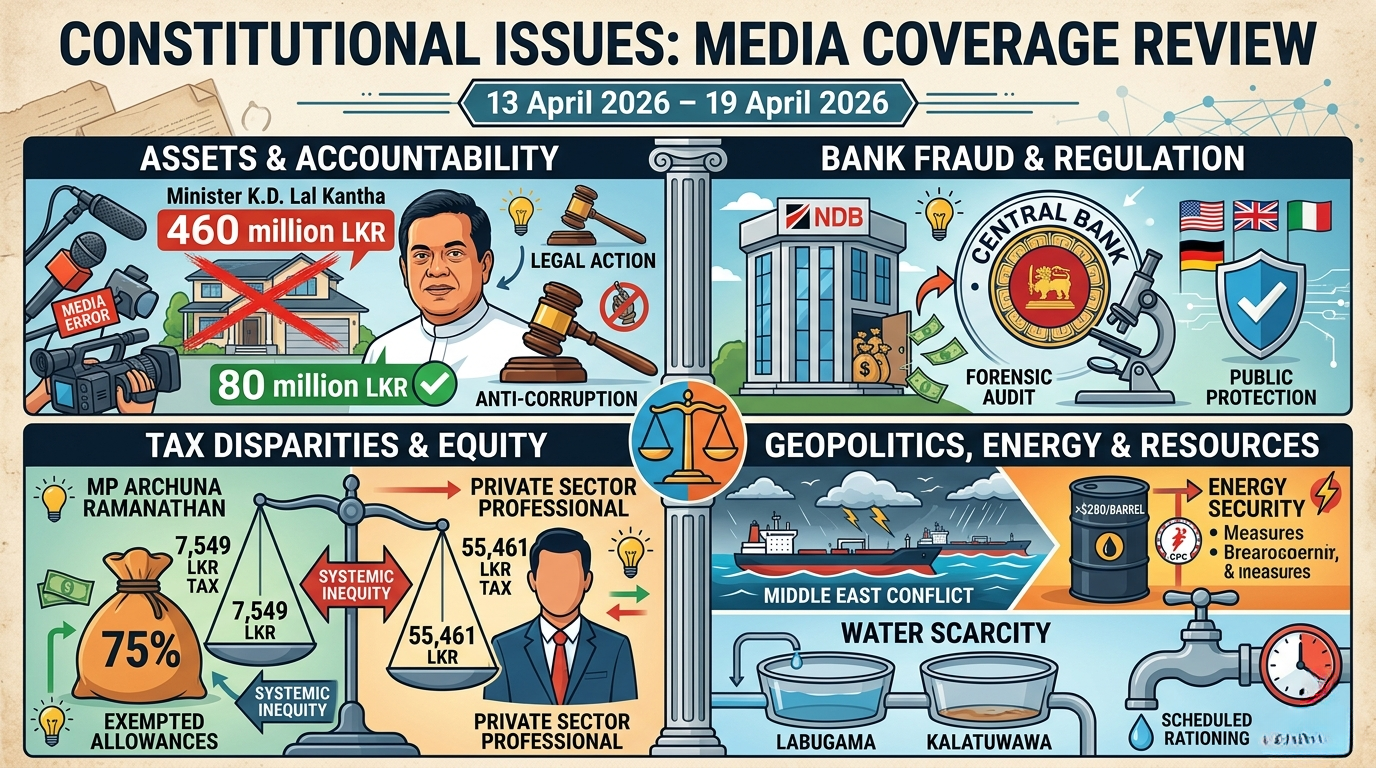
In concern to the alleged asset declaration of Minster K.D. Lal Kantha, while initial reports suggested substantial assets, a major reporting error significantly led to a revision of total assets from approximately LKR 460 million to around LKR 80 million.
The issue was further complicated by alleged inconsistencies between the Minister’s prior public statements and the disclosed assets, as well as claims of omitted property. In response, the Minister has initiated legal action citing reputational harm, while public calls have emerged for investigation by anti-corruption authorities.
Constitutionally, this situation engages with principles of accountability of public officials, equality before the law, integrity of anti-corruption mechanisms, the public’s right to information, freedom of expression, and the responsibilities of the media in ensuring accurate reporting. This incident reflects the importance of credible asset declaration systems and effective oversight by independent institutions. It also highlights the constitutional tension between media freedom and accountability.
Bank Fraud, Financial Regulation, and Public Protection
Recent reports of internal fraud at the National Development Bank (NDB) have raised concerns about financial regulation, public fund safety, and systemic stability. The Central Bank of Sri Lanka has intervened by initiating a forensic audit through international experts, directing improvements to internal controls and governance, and requiring an independent third-party review of institutional practices.
Constitutionally, this issue engages with public finance accountability, regulatory oversight, and the rule of law. It raises the State’s obligation to safeguard public funds and ensure transparency within the financial system. The incident indicates the need for strong and independent financial regulations to maintain public confidence and economic stability.
Tax Disparities, Equity, and Public Finance Governance
MP Archuna Ramanathan’s salary disclosure highlighted significant disparities in Sri Lanka’s income tax framework. While the MP earns a gross monthly income of approximately LKR 415,169, he reported paid only around LKR 7,549 in tax, compared to approximately LKR 55,461 paid by a private sector professional earning the same amount. This discrepancy is largely attributed to preferential tax treatment afforded to certain allowances received by public officials. Under existing administrative practice, only 25% of key allowances, such as fuel, telephone, and transport, is subject to taxation, with the remaining 75% exempted on the basis that such expenses are incurred for official purposes.
Constitutionally, this situation concerns principles relating to equality before the law, fairness in taxation, and parliamentary control over public finance. The issue also implicates the principle of horizontal equity in taxation, namely, that individuals with equal income should bear equal tax burdens. The apparent disparity raises concerns regarding systemic inequities within the tax regime, potentially undermining public confidence in fiscal fairness and governance. Preferential treatment of public officials may conflict with constitutional expectations of equal treatment and accountability.
Geopolitics Crisis, Energy Security, and Economic Governance
The Middle East conflict has generated concerns regarding fuel pricing, supply stability, and broader economic governance in Sri Lanka. Sri Lanka had also, at one point, paid substantially above global market rates for fuel imports. While the Ceylon Petroleum Corporation initially rejected these claims, it later clarified that refined diesel had been purchased at elevated prices exceeding USD 280 per barrel. Despite these challenges, the Government has taken steps to ensure energy security, including continued crude oil imports, diversification of supply sources beyond the Middle East, and exploration of concessional arrangements with alternative partners. Measures to sustain electricity generation through fuel procurement have also been reported.
These developments engage constitutional principles relating to economic governance, public finance management, and the State’s obligation to ensure access to essential services such as energy. They also raise issues concerning executive decision-making in international economic relations and the need for transparency in public procurement. The situation underscores the constitutional importance of ensuring accountability and transparency in the procurement and pricing of essential resources.
Water Scarcity, Resource Governance, and Emergency Management
Recent reports reveal declining water levels in key reservoirs namely Labugama Reservoir and Kalatuwawa Reservoir raising concerns over water availability and resource management. Authorities have initiated coordinated measures, including the establishment of a special operational committee to manage the crisis, implementation of scheduled water rationing to ensure equitable distribution, and continuous monitoring of water levels, production capacity, and supply systems. Efforts have also been made to enhance public communication by providing advance notice of water cuts, thereby improving transparency and minimising public disruption.
Constitutionally, these incidents engage with principles relating to the State’s responsibility to ensure access to essential resources, public health, and environmental protection. They also implicate governance norms concerning administrative efficiency, transparency, and equitable allocation of limited resources. The constitutional importance of effective disaster preparedness and resource governance is seen. The situation emphasises the necessity of sustainable water management policies, strengthened institutional capacity, and proactive planning to address climate-related challenges within a constitutional framework.


Comments (0)
Sign in to leave a comment
No comments yet. Be the first to comment!