
Issues of the Country and the Constitution
(Review of Media Coverage: 17 March 2026 – 23 March 2026)
This week’s issues shed light on significant constitutional questions relating to economic governance of essential services, national security law reform, anti-corruption and institutional accountability, social justice regulation, and the exercise of sovereignty in a complex external environment. These issues reflect the need for strengthened constitutional safeguards, transparency, and rule-of-law principles within Sri Lanka’s governance framework.
Concerns of the Energy Sector
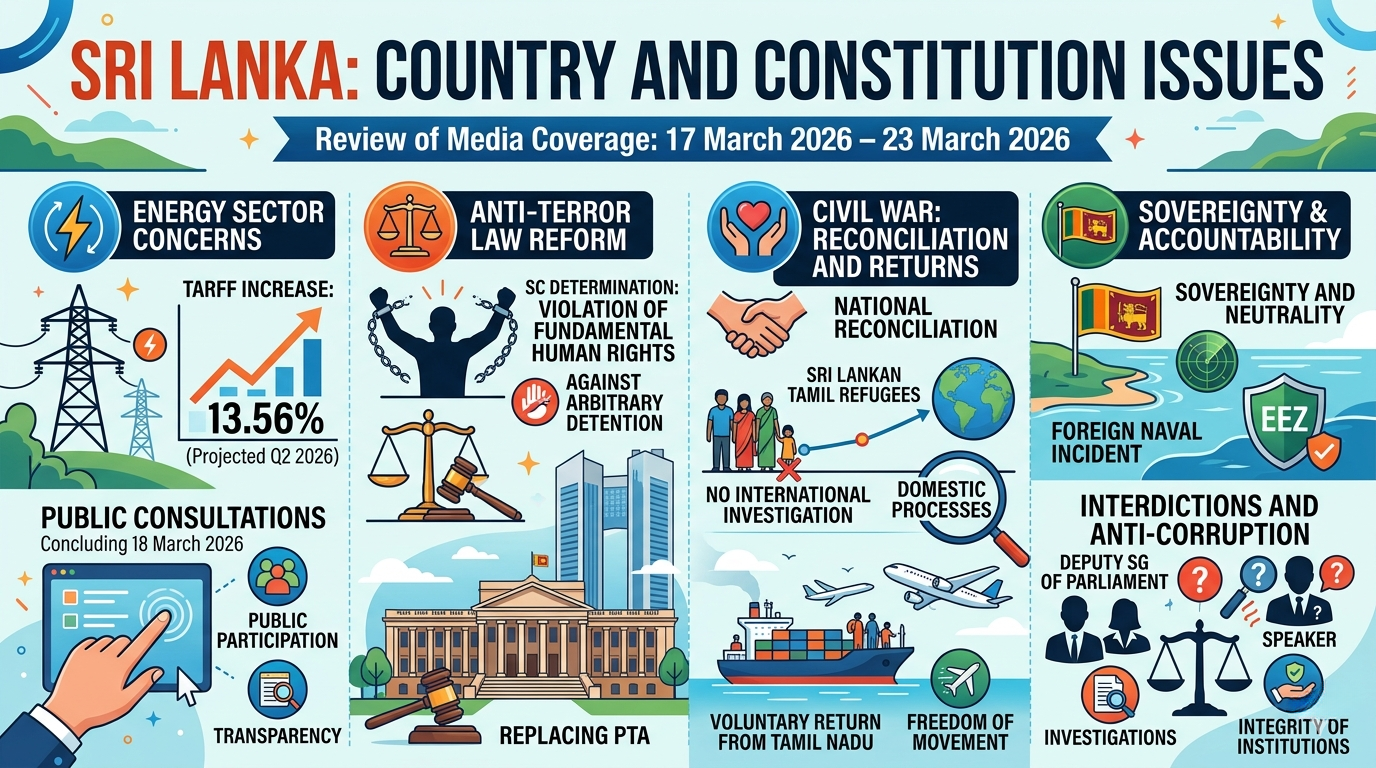
While the restructuring of the Ceylon Electricity Board (CEB) continues under the Electricity Act No. 36 of 2024, the sector faces financial and operational pressure. The CEB has requested a 13.56% tariff increase for the second quarter of 2026 to address a projected revenue shortfall, with public consultations concluding on 18 March and a regulatory decision expected by the end of the month.
Constitutionally, this engages principles relating to governance of state-owned enterprises, independence of economic regulators, public finance discipline, transparency in tariff-setting, and the state’s obligation to ensure equitable access to essential services. The parallel progression of structural reform and tariff adjustment highlights the constitutional importance of ensuring that independent regulatory bodies function with autonomy, transparency, and accountability. The legitimacy of tariff-setting processes depends on meaningful public participation, reasoned decision-making, and protection of consumer interests.
The Anti-Terror Law Reform
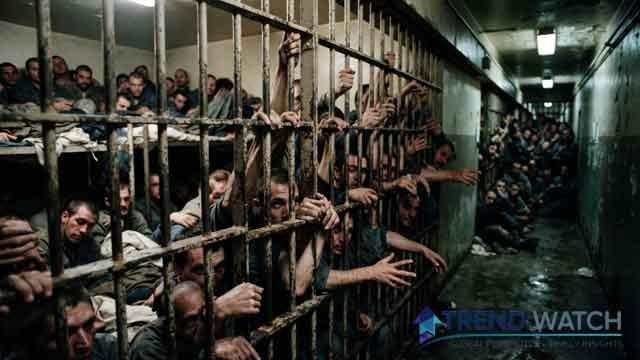
The government continues to signal the replacement of the Prevention of Terrorism Act (PTA), and in a related development, the Supreme Court determined that the detention of an individual under the PTA violated fundamental human rights, reinforcing constitutional protections against arbitrary detention.
Constitutionally, this issue engages with protections relating to personal liberty, due process, freedom from arbitrary arrest and detention, and judicial control over executive powers exercised in the interest of national security. The judicial determination provides an important constitutional benchmark for evaluating future anti-terrorism legislation.
Concerns of the Civil War
The government has reiterated that it will not pursue an international investigation into incidents relating to persons reported missing during the period of the civil war. It has also expressed readiness to accept the voluntary return of Sri Lankan Tamil refugees currently residing in Tamil Nadu, India. This initiative is framed as part of broader efforts to promote long-term national reconciliation and social cohesion.
Constitutionally, these developments engage with principles relating to the right to life and dignity, equality and non-discrimination, citizenship and legal identity, freedom of movement and return, and the State’s obligations in relation to accountability, reconciliation, and protection of displaced persons. It also raises questions concerning the scope of international accountability mechanisms and the role of domestic processes in addressing past human rights violations. The developments highlight the constitutional importance of ensuring credible and transparent mechanisms to address enforced disappearances and to uphold the rights of affected families. The decision to rely on domestic processes reflects the need for independent, effective, and trusted accountability institutions. These developments also reflect the broader constitutional objective of national reconciliation, requiring that return and reintegration processes be inclusive, non-discriminatory, and grounded in long-term social cohesion and justice.
Sovereignty, Neutrality, and Continuity of Public Services
Reports of a foreign naval incident within Sri Lanka’s Exclusive Economic Zone (EEZ), alongside subsequent humanitarian and operational responses, generated public debate concerning national sovereignty and adherence to a policy of neutrality in international conflicts. At the same time, domestic energy constraints, including fuel shortages and service disruptions, prompted government measures aimed at ensuring continuity of public services, including administrative adjustments and emergency responses.
Constitutionally, these developments engage with principles relating to state sovereignty, executive authority in foreign affairs and defense, parliamentary oversight of international engagements, and the continuity of government and essential public services during emergencies. They highlight the constitutional importance of clearly defined frameworks governing foreign military interactions, neutrality in international conflicts, and the exercise of emergency powers.
Interdictions
The Deputy Secretary General of Parliament, Chaminda Kularatne, was interdicted following allegations of irregularities in his appointment and financial benefits. At the same time, he has lodged complaints against the Speaker before CIABOC, while multiple corruption-related allegations have also been raised against the Speaker. Investigations into both sides are ongoing.
Constitutionally, this matter engages principles relating to separation of powers, legality of administrative action, due process (including the right to be heard), independence of parliamentary administration, and the integrity and independence of anti-corruption institutions, particularly in the context of potential conflicts of interest. They also reflect the need for proper legal frameworks governing disciplinary control within Parliament and strict adherence to due process safeguards.
Comments (0)
Sign in to leave a comment
No comments yet. Be the first to comment!