
Issues Concerning the Constitution
(Review of media coverage: 10 March 2026 – 16 March 2026)
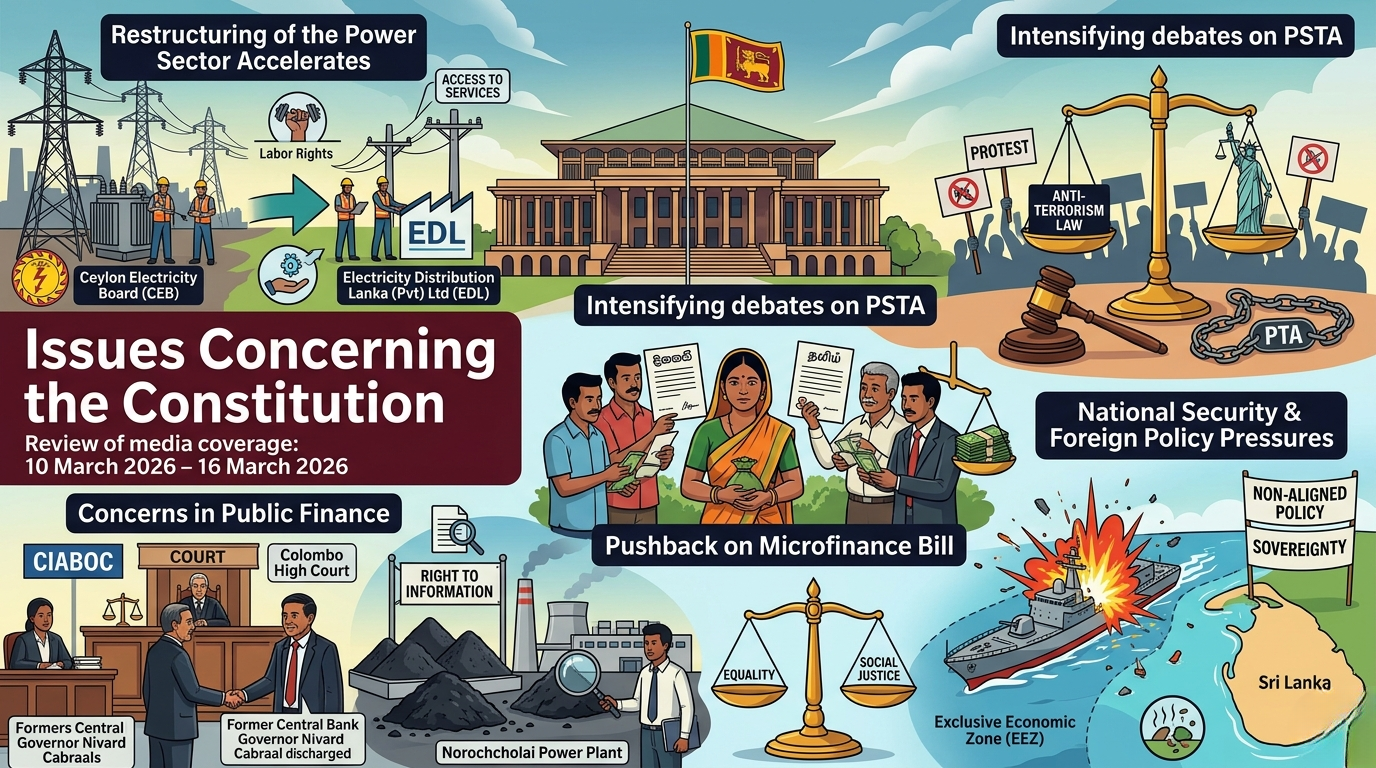
The 11th week of the year highlights incidents which raise significant constitutional questions relating to economic reform in essential public services, national security legislation, financial regulation and social protection, public-sector accountability, and foreign policy and sovereignty. They reflect the (importance of strengthening institutional safeguards, transparency, and rule-of-law principles within Sri Lanka’s evolving constitutional framework.
Restructuring of the Power Sector Accelerates
The restructuring of the Ceylon Electricity Board (CEB) moved into the phase of implementation with the establishment and operationalism of several new state-owned entities. Electricity Distribution Lanka (Pvt) Ltd (EDL) has assumed distribution functions previously carried out by the CEB.
While the Electricity sector trade unions staged industrial action citing concerns over job security and employment terms, the Minister agreed to key union demands.
Constitutionally this reform engages with principles relating to governance of state-owned enterprises, independence of economic regulation, public finance discipline, labour rights, and the state’s obligation to ensure access to essential services. This unbundling reflects the constitutional importance of regulatory independence, transparence, and accountability. The legitimacy of these reforms depends on ensuring that regulatory bodies operate free from political or commercial capture, that tariff-setting mechanisms remain transparent and subject to public scrutiny, and that labour protections are maintained during institutional transition. The industrial actions reflect the constitutional necessity of balancing freedom of association and collective bargaining with narrowly tailored limitations.
Intensifying debates on PSTA
The Government proposed anti-terrorism law was strongly opposed by civil society organisations suggesting that the proposed laws appear to be more restrictive than the existing PTA. Political actors also called for the complete repeal of the PTA.
Constitutionally, the proposed legislation engages protections relating to personal liberty, due process, protection against arbitrary arrest and detention, and judicial oversight of executive power exercised in the name of national security. The debate highlights the constitutional requirement that any anti-terrorism framework must be narrowly defined, proportionate, and subject to strict judicial control. The continued reliance on extraordinary security legislation reflects the need for clear constitutional safeguards. It also reflects the importance of embedding minimum due-process standards within the constitutional framework.
Pushback on Microfinance and Credit Regulatory Authority Bill
The proposed Microfinance and Credit Regulatory bill seeks to establish an independent regulatory authority, introduce licensing requirements for moneylenders, cap interest rates and fees, regulate debt collection practices, and mandate simplified contracts in Sinhala and Tamil. Civil society organisations and affected communities, especially women in rural areas, criticised the bill suggesting that it may inadequately address exploitative lending practices and structural indebtedness.
Constitutionally, the bill engages principles relating to equality before the law, language rights, access to justice, and protection from exploitative economic practices. The proposed bill highlights the constitutional importance of safeguarding vulnerable populations within financial systems. The criticism reflects the need for effective remedies and enforcement mechanisms, emphasising that regulatory reform must be aligned with broader constitutional principles of social justice and protection against economic exploitation.
Concerns in Public Finance
This week noted two concerns in relation to public finance. The Colombo High Court discharged former Central Bank Governor Nivard Cabraal and others following the withdrawal of charges by the Commission to Investigate Allegations of Bribery or Corruption (CIABOC), which cited the existence of a separate investigation.
Transparency concerns were raised regarding coal procurement for the Norochcholai power plant, with civil society organisations seeking information through Right to Information (RTI) mechanisms amid allegations of irregularities, substandard supplies, and significant financial losses.
Constitutionally, these developments engage principles relating to public finance accountability, independence of prosecutorial and investigative bodies, transparency in public procurement, and the right to information. These issues reflect structural weaknesses in accountability mechanisms. They also reflect the importance of maintaining public confidence in governance systems.
National Security and Foreign Policy Pressures amid Regional Conflict
Reports suggest that an Iranian naval vessel was destroyed near Sri Lanka’s Exclusive Economic Zone (EEZ), with debris and related environmental effects reported along the southern coastline. The Government maintained that its actions were consistent with international law, while also taking measures to manage economic and humanitarian consequences. Public debate emerged regarding Sri Lanka’s adherence to its traditional non-aligned foreign policy and the implications for national sovereignty.
Constitutionally, this engages with principles relating to state sovereignty, executive authority in foreign affairs and defence, parliamentary oversight of international engagements, and environmental protection. This incident reflects the constitutional importance of clear frameworks governing foreign military activity, emergency responses, and international cooperation. Moreover, the environmental implications of conflict-related incidents reinforce the importance of integrating environmental protection within the constitutional order.

Comments (0)
Sign in to leave a comment
No comments yet. Be the first to comment!