
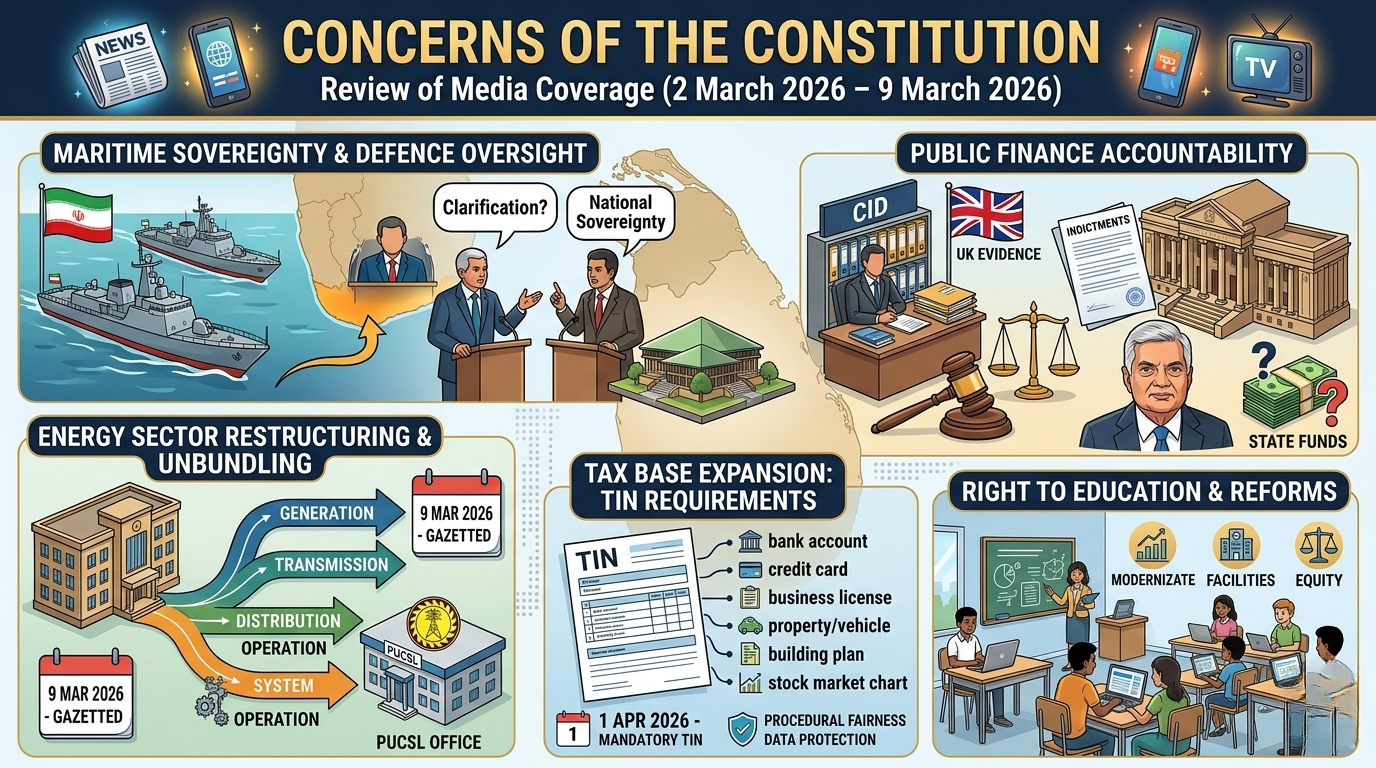
Concerns of the Constitution
Review of Media Coverage (2 March 2026 – 9 March 2026)
This week’s media coverage reflects developments which raise significant constitutional questions which suggest the importance of strengthening constitutional oversight, rule-of-law safeguards, and democratic accountability in the exercise of public power within Sri Lanka’s constitutional framework.
Sovereignty, Foreign Affairs, and Defence Oversight
The week noted reports on two Iranian vessels near Sri Lanka’s southern maritime zone and Colombo. Opposition leaders called for clarification from the Government, questioning whether foreign powers had informed Sri Lanka in advance and raising concerns regarding the protection of national sovereignty. The Government reinstated that Sri Lanka would adhere to international law and continue maintaining the non-aligned foreign policy without supporting any party in conflict.
Constitutionally, this incident engages with principles relating to state sovereignty, executive authority in foreign affairs and defense policy, and parliamentary oversight of security cooperation and international engagements. It highlights institutional gaps in transparency and accountability regarding external security incidents and defence cooperation involving foreign powers. It also reflects the constitutional importance of clear procedures governing treaty-making, military cooperation agreements, and disclosure of security arrangements, together with effective parliamentary scrutiny to safeguard sovereignty and maintain public confidence in the conduct of foreign and defence policy.
Restructuring of the Energy Sector
With the gazetting of the Electricity Act No.36 of 2004 into operation from 9 March 2026, the restructuring of the Ceylon Electricity Board was initiated. The reform unbundles the utility into several state-owned entities responsible for generation, transmission, distribution, and system operation. It intends to improve efficiency, reduce financial losses, strengthen regulatory oversight through the Public Utilities Commission of Sri Lanka (PUCSL), and enable greater private sector participation in the electricity sector.
Constitutionally, this engages principles relating to governance of state-owned enterprises, executive reliance on delegated legislation, independence of economic regulators, and labour protections in public-sector restructuring. The unbundling of a major public utility highlights the constitutional importance of transparent governance, regulatory accountability, and parliamentary oversight where structural reforms to essential services are undertaken. Its legitimacy will depend on safeguarding consumer interests, protecting employee rights during institutional transition, and ensuring reliable and equitable access to electricity as a critical public service.
Tax Base Expansion
The Government announced that from 1 April 2026, the Inland Revenue (Amendment) framework will require individuals to provide a Taxpayer Identification Number (TIN) when accessing a wide range of public and private services including opening bank accounts, obtaining credit cards, registering businesses, property and vehicle registration or renewals, building plan approvals, and certain financial transactions such as stock market activities. This is done to expand the national tax base, improve revenue administration, and strengthen fiscal capacity.
Constitutionally, this involves principles in relation to equality before the law, reasonableness in administrative action, and protection of personal data within state regulatory systems. Even though expanding the tax base is central to fiscal accountability, this measure raises questions of proportionality and procedural fairness. It highlights the constitutional need for clear safeguards in tax administration, including data protection standards, transparency in the collection and use of personal information, and accessible review or appeal mechanisms to prevent unreasonable exclusion from essential public services.
Right to Education
The Government announced that education reforms are progressing, aiming to modernise curriculum structures, improve school facilities, and address disparities within the national education system.
Constitutionally, these reforms engage constitutional principles relating to the right to education, equality of opportunity, and the responsibility of the state to ensure equitable access to quality public education. While the proposed reforms highlight the constitutional importance of embedding guarantees for inclusive and high-quality education within the governance framework of the education sector, they also raise the need for transparent, evidence-based policy reforms, independent oversight of education standards, and equitable allocation of resources across regions to ensure that structural changes strengthen rather than deepen educational inequality.
Public Finance Accountability
In concern to the misuse of state funds case involving former President Ranil Wickremesinghe, the Criminal Investigation Department (CID) is pursuing additional evidence, including material located in the United Kingdom, while the Attorney General indicates the possibility of filing indictments before a higher court.
Constitutionally, this matter engages principles relating to accountability of public officials, integrity in public finance management, and the independence of investigative and prosecutorial institutions. It emphasises the constitutional importance of mechanisms which ensure that even the highest public office holders remain subject to the law. The case highlights the need for clear legal frameworks governing the use of public funds, strengthened institutional independence for investigations and prosecutions, and transparent safeguards to prevent conflicts of interest and misuse of state resources.



Comments (0)
Sign in to leave a comment
No comments yet. Be the first to comment!