
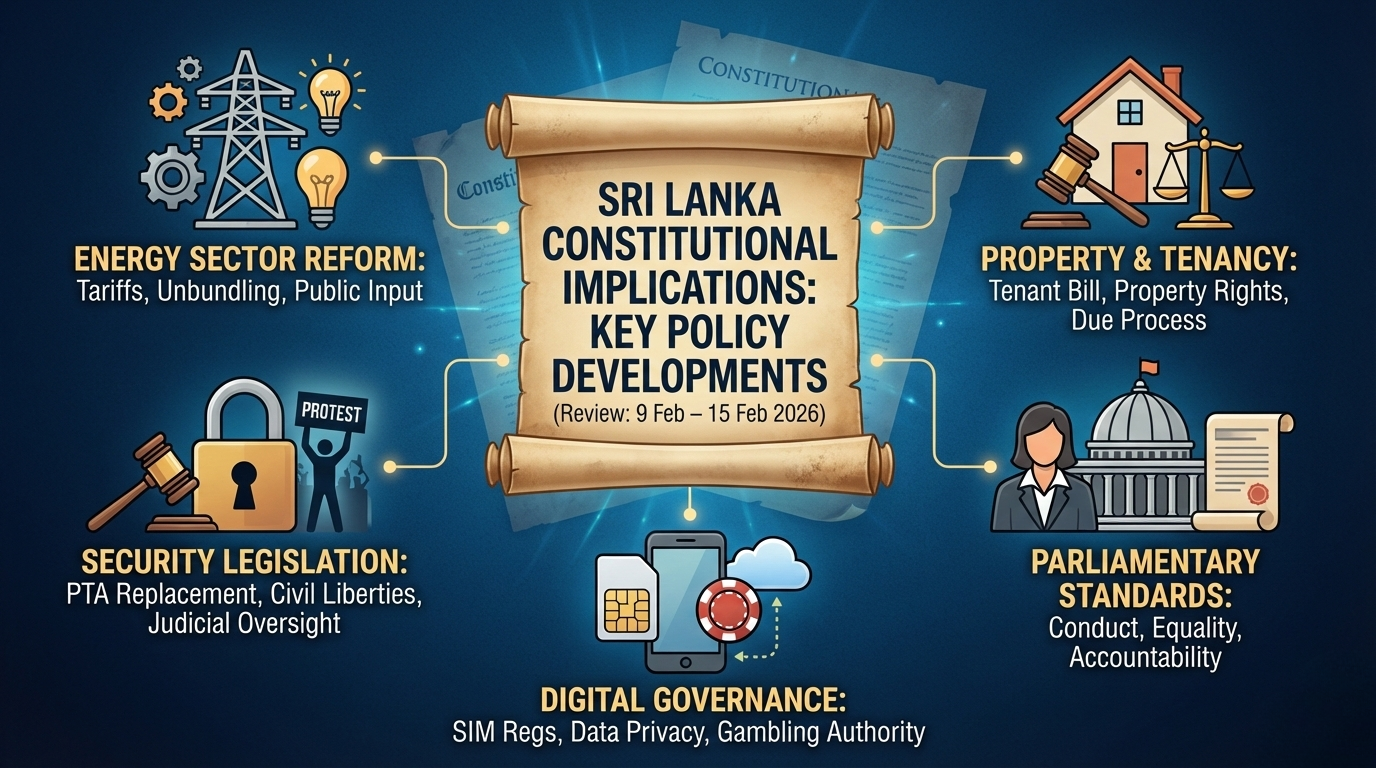
Constitutional Implications of Key Policy Developments
(Review of Media Coverage: 9 February 2026 – 15 February 2026)
This week’s media analysis highlights developments that raise significant constitutional questions relating to economic governance, security legislation, property rights, parliamentary standards, digital regulation, and institutional accountability. These developments raise broader concerns about the adequacy of Sri Lanka’s constitutional framework in addressing such challenges.
Energy Sector Reform
The draft National Electricity Policy was published under the Electricity (Amendment) Act No. 36 of 2024, with the Ministry of Power and Energy initiating a public consultation process. The policy proposes cost-reflective tariffs with targeted subsidies, the structural unbundling of the Ceylon Electricity Board into separate generation, transmission, and distribution entities, grid digitalisation including smart metering, and alignment with IMF-supported reforms. Media reports also suggest plans to repeal the long-standing Electricity Act as reforms near completion. These measures signal a shift towards market-driven governance.
Constitutionally, this transition creates tension: although utility pricing has traditionally been treated as an administrative decision, in an era of digital grids and IMF-aligned debt sustainability, tariff-setting increasingly implicates questions of financial sovereignty and Parliament’s control of public finance under Article 148 of the Constitution. Accordingly, reforms may require stronger parliamentary oversight mechanisms, such as mandatory public oral hearings and enhanced Auditor General scrutiny for tariff revisions, in order to embed transparency and accountability. Framed this way, electricity provision moves from being perceived as a discretionary political benefit to a transparently regulated public service grounded in constitutional principles of participation, equality, regulatory independence, and protection of vulnerable consumers.
Security Legislation
The Government is advancing new legislation to replace the Prevention of Terrorism Act, proposing a narrower definition of terrorism, limits on detention, improved access to legal counsel, and stronger judicial oversight. While discussions with international partners are still ongoing, international experts and media reports have expressed concern that parts of the draft law could still affect civil liberties, including dissent, journalism, minority rights, and trade union activity.
Constitutionally, such security legislation directly engages fundamental rights such as personal liberty, due process, freedom of expression, and freedom of association. The reform process therefore serves as an important test of constitutional limits on state power, reflecting the need for clear legal definitions, proportionate restrictions, prompt judicial supervision of detention, and effective safeguards to prevent abuse of security powers. Reform must entrench Article 4 alongside Article 3. By making judicial oversight of detention an inviolable part of the Basic Structure, the state cannot "creep" into authoritarianism through secondary legislation.
Property and Tenancy Reforms
The Government informed the Supreme Court that the proposed Protection of Occupants (Tenant) Bill would be reconsidered and opened a one-month period for public comments. Fundamental rights concerns had been raised, particularly regarding provisions that could criminalise property owners who obstruct court-ordered restitution. The 2023 Act on Repossession of Premises Let or Leased remains in force.
Constitutionally, the issue engages protections relating to property rights, equality before the law, due process, and judicial review. The episode highlights the role of judicial scrutiny and public consultation in legislative reform affecting property and occupancy rights, and reinforces the need for proper notice, fair hearing, reasoned decision-making, and a balanced protection of both owners and occupants within a constitutional framework.
While Article 16 continues to protect archaic tenancy laws that may be inconsistent with modern equality, a new constitution should phase out Article 16 to ensure that property and tenancy disputes are governed by Article 12 (Equality).
Parliamentary Standards and Internal Accountability
The Women Parliamentarians’ Caucus has proposed amendments to Standing Orders to address verbal abuse and obstruction directed at women Members of Parliament, at a time when the 10th Parliament has recorded its highest level of female representation. Separately, draft legislation to abolish MP pensions has been cleared by the Attorney General, approved for gazetting, and endorsed by a Sectoral Oversight Committee, with public debate supporting an EPF/ETF-style alternative.
Constitutionally, these developments engage principles of parliamentary integrity, equality, non-discrimination, and institutional accountability. They reflect broader concerns about standards of conduct, public trust, and internal accountability within representative institutions, while maintaining respect for parliamentary autonomy.
A suitable reform would be to amend Article 3 to define sovereignty as founded upon the pluralistic character of the people. This creates a judicial shield where parliamentary conduct that excludes a specific group can be challenged as unconstitutional.
Digital Governance and Economic Regulation
The Cabinet approved amendments to SIM registration regulations requiring re-registration of SIMs issued before 2 August 2019 due to incomplete verification, allowing registration for individuals aged 16–17, and tightening rules for foreign nationals. At the same time, the Gambling Regulatory Authority Act No. 17 of 2025 came into force to regulate land-based, online, offshore, and Port City gambling operations, with full operationalisation targeted by mid-2026.
Constitutionally, these measures engage protections relating to privacy, freedom of expression, freedom of association, and regulatory oversight of high-revenue sectors. They raise concerns about data protection, surveillance safeguards, and proportional limitations on digital rights, while highlighting the importance of independent regulatory authorities, transparent licensing processes, and effective parliamentary scrutiny of secondary legislation.
A new constitution must introduce a Digital and Data Protection Commission as a high-level independent body. This commission should monitor how AI and biometric data (like SIM registration) are used, ensuring that surveillance does not replace governance.



Comments (0)
Sign in to leave a comment
No comments yet. Be the first to comment!