
Introduction
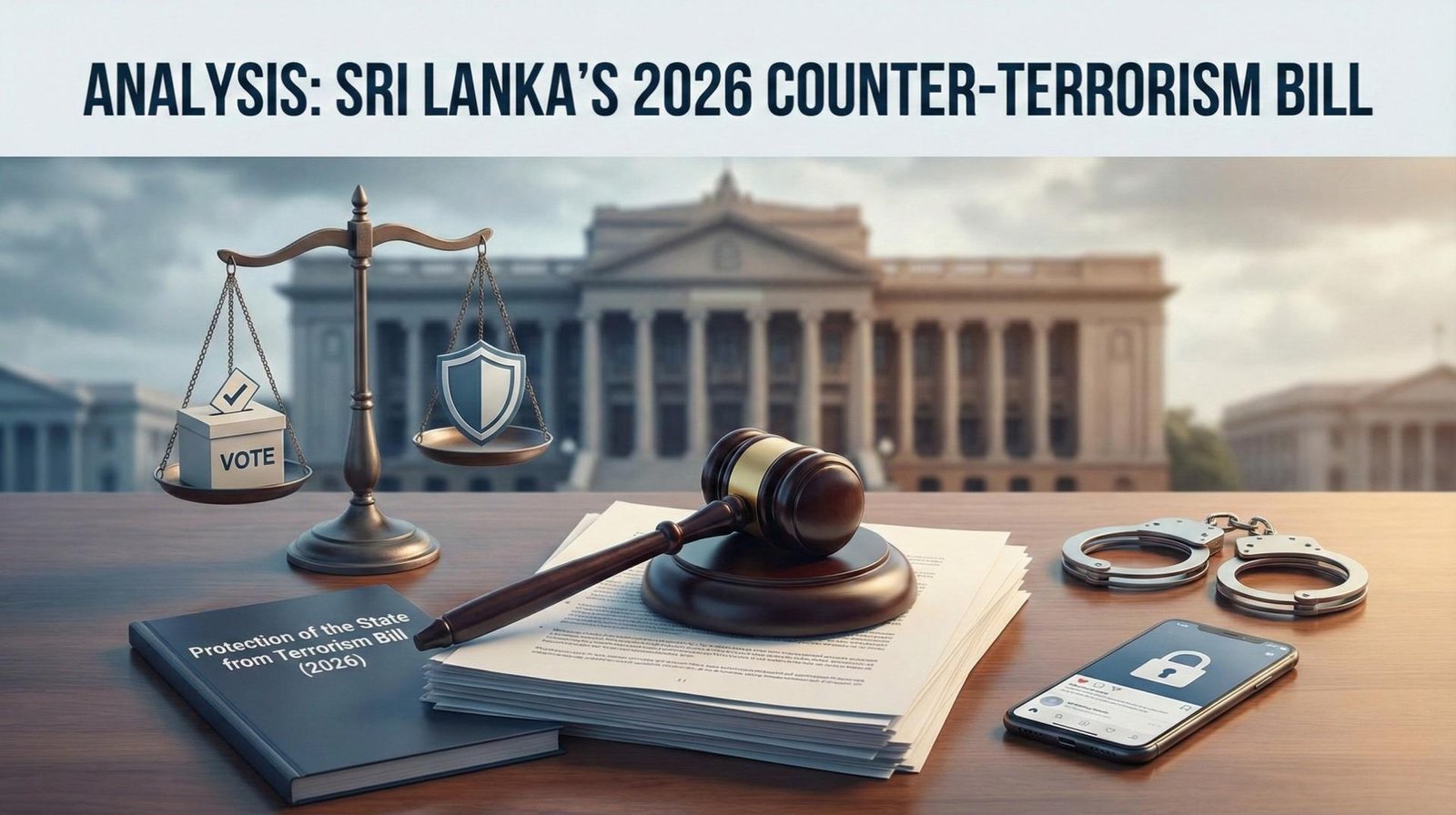
The Protection of the State from Terrorism Bill (2026) represents a comprehensive effort to repeal and replace the Prevention of Terrorism (Temporary Provisions) Act, No. 48 of 1979, which has governed Sri Lanka’s counter-terrorism landscape for nearly half a century. While the Bill’s preamble explicitly recognizes the rule of law and the fundamental rights guaranteed under the Constitution and international human rights instruments, its substantive clauses introduce a specialized legal framework that often diverges from standard criminal law.
This analysis examines the Bill by evaluating its alignment with the following legal standards:
- Constitutional and International Human Rights: Assessing how the Bill’s broad definitions of terrorism and powers of proscription impact Fundamental Rights and the International Covenant on Civil and Political Rights (ICCPR).
- Standard Criminal Procedure: Identifying specific departures from the Code of Criminal Procedure Act, particularly regarding detention timelines and the admissibility of evidence.
- Freedom of Expression: Analyzing the implications of new “reckless” encouragement and publication offenses for journalists, social media users, and political activists.
- Digital Privacy: Reviewing the expanded state powers to bypass encryption and intercept electronic communications under judicial oversight.
By synthesizing these areas, the analysis aims to determine the extent to which the Bill achieves an equilibrium between national security interests and the protection of individual liberties.
Equilibrium between state security and the rights of the accused
The key to analyzing the Protection of the State from Terrorism Bill (2026) is to assess the balance between state security and accused rights, focusing on procedural updates and the continued executive framework of the Prevention of Terrorism Act (1979). Essential themes related to this balance should be discussed.
1. Strengthening the Rights of the Accused (Developments)
The Bill introduces several judicial and medical safeguards that align more closely with ordinary criminal law:
- Admissibility of Confessions: Confessions to police officers are no longer admissible as evidence. Instead, statements must be made before a Magistrate under specific conditions, including a mandatory medical examination before and after the statement to prevent torture.
- Attorney Access and Notifications: It explicitly requires that an arresting officer notify the next of kin within 24 hours. It also guarantees the right to communicate with an Attorney-at-Law and relatives.
- Judicial Oversight of Welfare: Magistrates are required to visit detention sites monthly and personally verify the well-being of suspects.
2. Shifts Toward Criminal Justice/State Power (Aggravations)
It is argued here that the Bill tilts the balance back toward the state through over-broad definitions and executive control:
- Militarization of Arrest Powers: The power to search, stop, and arrest suspects—previously primarily a police function—is extended to the armed forces and coast guard, who lack specific training in civilian law enforcement.
- Executive Detention Control: The Secretary of Defense retains the power to issue Detention Orders for up to one year without initial judicial review. While a Magistrate must eventually “give effect” to these orders, they may have no power to release a suspect even if they find the detention unjustified.
- Prolonged Remand: A suspect can be held for an aggregate of two years without being formally charged.
- Information Asymmetry: The use of “confidential reports” in Section 35 means that the specific findings used to justify extending a detention may be hidden from the accused and their legal counsel.
3. Equilibrium Assessment
While the Bill “repackages” many PTA provisions with better procedural language, the core equilibrium remains heavily weighted toward the executive branch.
| Feature | Equilibrium Status | Legal Basis |
|---|---|---|
| Search & Arrest | Aggravated | Extended to armed forces/coast guard without warrant |
| Evidence | Improved | Police confessions removed; Magistrate statements regulated. |
| Detention | Stable/Aggravated | Still executive-led; total 2-year threshold before mandatory bail if no indictment. |
| New “reckless” offences | Aggravated | Expanded encouragement/publication offences may chill speech. |
Additional points of departure
1. Divergence from the International Covenant on Civil and Political Rights (ICCPR)
The ICCPR emphasizes the right to a fair and prompt trial and protection from arbitrary detention.
- Extended Detention Without Judicial Oversight: Section 29 allows the Secretary (Ministry of Defense) to issue a Detention Order for up to two months initially, which can be extended up to an aggregate of one year. This executive-driven detention conflicts with the ICCPR principle that anyone arrested should be brought promptly before a judge.
- Broad Definition of Terrorism: Section 3(1) defines terrorism through broad consequences like “intimidating the public” or “compelling the Government”. International bodies often argue that such vague language can be used to criminalize peaceful dissent, violating the ICCPR’s protections for freedom of expression and assembly.
- Restriction Orders: Section 64 allows for “Restriction Orders” on movement and communication for up to six months based on “reasonable grounds to believe” a person is preparing an offence, which may infringe on the right to liberty and freedom of movement.
2. Divergence from Fundamental Rights (SL Constitution, Chapter III)
The Sri Lankan Constitution guarantees equality before the law (Art 12) and freedom from arbitrary arrest (Art 13).
- Supremacy Clause: Section 74 explicitly states that this Act prevails over all other written laws in the event of inconsistency. This effectively subordinates standard legal protections to the provisions of this Bill.
- Admission of Statements: While Section 61(2)(a) states a person is not bound to incriminate themselves, Section 60(4) makes statements made to a Magistrate admissible in evidence against the person under specific conditions.
- Curfew and Prohibited Places: Sections 65 and 66 grant the President and Secretary broad powers to declare curfews or “prohibited places”. If used to block access to sites of public protest, these may infringe on the freedom of peaceful assembly.
3. Divergence from the Criminal Procedure Code (CPC) of Sri Lanka
The Bill creates a parallel legal track that bypasses standard CPC protections.
- Exclusion of Standard Bail Provisions: Section 41(2) specifically states that Sections 115 and 116 of the CPC (regarding remand and bail) have no application to suspects under this Act.
- Limited Judicial Discretion on Bail: Under Section 28(3), a suspect is only entitled to bail if an indictment is not preferred within two years. This is significantly longer than standard CPC timelines.
- Arrest by Armed Forces: Section 19 extends the powers of search and arrest—normally reserved for police—to members of the armed forces and coast guard.
- No Mitigation for Guilty Pleas: Section 41(3) removes the applicability of Section 306 of the CPC, meaning certain discharge or probation options are unavailable for those found guilty under this Act.
4. Divergence from international laws on terrorism prevention
International standards (such as those from the UN Special Rapporteur) require counter-terrorism laws to be “precise” and “necessary.”
- Vague “Associated” Offences: Section 6 lists a wide array of activities—such as “espousing the cause” or “distributing material” for a proscribed organization—as offences. Without a strict requirement for “criminal intent” to support violence, this risks capturing humanitarian or journalistic work.
- Encouragement vs. Incitement: Section 9 criminalizes the “encouragement” of terrorism, including through “recklessness”. International standards generally prefer the stricter standard of “incitement to violence,” as “encouragement” is seen as too subjective.
- Lack of Immediate Judicial Review: While Section 26 requires a suspect to be produced before a Magistrate within 48 hours, if a Detention Order exists, the Magistrate’s role is largely to “give effect” to that executive order rather than to re-evaluate the necessity of the arrest.
Comparison of Detention and Remand Timelines
| Feature | Standard Criminal Procedure Code (CPC) | Protection of the State from Terrorism Bill (2026) |
|---|---|---|
| Production before Magistrate | 24 hours (excluding travel time) | Within 48 hours (excluding travel time) |
| Initial Extension of Custody | Magistrate may authorize further detention for a total of 15 days | Magistrate may authorize an additional 24 hours for further investigation |
| Executive Detention Orders | Not available under standard criminal law | The Secretary (Defence) can issue a Detention Order (DO) for 2 months initially (extendable up to 1 year in aggregate) |
The new bill aims to replace current criminal justice measures set by the criminal procedure code.
- Supremacy of the Bill: Section 74 ensures that in any conflict regarding these timelines, this Bill overrides the CPC.
- Suspension of CPC Sections: The Bill explicitly states that Sections 115 and 116 of the CPC (which govern the standard 15-day remand and bail procedures) do not apply to these suspects.
- Executive vs. Judicial Power: While the CPC places the power to deprive liberty solely with the Judiciary after the initial 24 hours, this Bill grants the Secretary to the Ministry of Defense the power to authorize detention for up to a year, shifting the balance from judicial to executive oversight.
- The “Two-Year” Threshold: Under Section 28(3), the mandatory release on bail only triggers if an indictment has not been preferred within two years of arrest.
Section 35 “confidential report” mechanism
Analyzing the “confidential report” mechanism in Section 35 is crucial for any legal practitioner, as it introduces a significant layer of information asymmetry between the state and the defense during detention extension hearings.
The Nature of the Confidential Report
- Mandatory Filing: To extend detention beyond the initial two months, the Officer-in-Charge (OIC) of the police station must file a confidential report in the Magistrate’s Court.
- Contents: The report must include the specific allegations against the suspect, the findings of the investigation to date, and the specific reasons why further detention is necessary.
Impact on the Defense and the Role of the Attorney
- Non-Disclosure Rule: By default, this report is not disclosed to any person, including the suspect or their legal counsel.
- Judicial Discretion for Disclosure: An Attorney-at-Law cannot demand the report as a right. The Magistrate may only disclose it if they form the opinion that it is “in the interest of justice” to do so.
- The “Investigation Integrity” Proviso: Even if the Magistrate wants to disclose the report, they are legally bound to ensure that such disclosure does not “affect the investigation”.
- Challenge to Effective Representation: While Section 35(4) explicitly allows an Attorney-at-Law to raise objections to an extension, those objections may be purely speculative if the Attorney has not seen the “findings” or “reasons” cited in the confidential report.
Procedural Safeguards (and their Limits)
- In-Camera Proceedings: These hearings may be held in-camera (privately).
- Magistrate’s Refusal: The Magistrate does have the power to refuse the extension if they are not satisfied with the report’s contents, in which case they may remand the suspect or grant bail under the Bail Act.
- HRC Notification: The Magistrate must notify the Human Rights Commission of Sri Lanka of any extension granted.
This structure places the Magistrate in the difficult position of being the sole “gatekeeper” of evidence. For an Attorney, the strategy often shifts from challenging the evidence itself to arguing that the “interest of justice” outweighs the state’s interest in secrecy.
Contrast with the 1979 PTA
The Protection of the State from Terrorism Bill (2026) aims to replace the Prevention of Terrorism Act (PTA), No. 48 of 1979. Although it adds some procedural safeguards, critics argue that it mainly repackages or increases the state's repressive powers rather than advancing civil rights.
| Feature | Prevention of Terrorism Act (1979) | Protection of the State from Terrorism Bill (2026) |
|---|---|---|
| Definition of Terrorism | Broadly defined to include any act that causes “fear” or “unlawful activity”. | Broad consequences (e.g., “intimidating the public”) but excludes protest and dissent unless intent/knowledge of terror is proven. |
| Executive Detention | Minister of Defense could issue Detention Orders for up to 18 months | Secretary to the Ministry of Defense issues DOs for up to 1 year (in 2-month increments) |
| Total Remand Period | Suspects could languish for years without trial; bail extremely restricted. | Aggregate remand and detention can last up to 2 years before mandatory bail if no indictment is filed |
| Admissibility of Confessions | Confessions to police officers were admissible; allegations of torture common. | Police confessions not admissible; statements to a Magistrate are admissible if voluntary. |
| Arresting Authority | Primarily police officers | Power of arrest extended to armed forces and coast guard officers |
| Safeguards | Virtually none originally; later amendments added monthly Magistrate visits. | Mandatory medical exams, Attorney access, notifications to the Human Rights Commission (HRC). |
Does the new bill signify progress or deterioration compared to the current law?
1. Areas of Advancement (Enhancements)
- Removal of Confessions to Police: By making statements to a Magistrate the primary admissible evidence, the Bill attempts to reduce the incentive for police torture.
- Medical Oversight: The requirement for a Judicial Medical Officer to examine suspects before and after recording statements is a significant procedural safeguard against physical abuse.
- Exclusion of Legitimate Protest: Section 3(4) explicitly states that participation in strikes or protests is not, by itself, a basis for a terrorism charge.
2. Aspects of Aggravation (Regression)
- Expansion of Law Enforcement: Granting the military and coast guard the same arrest and search powers as police is seen by many as regressive.
- Vague “Speech” Offences: New offences like “encouragement of terrorism” or “dissemination of terrorist publications” (including “reckless” acts) may be used to target journalists or activists.
- Executive Dominance: The Secretary to the Ministry of Defence still retains the power to deprive a citizen of liberty for up to one year through Detention Orders.
- Information Asymmetry: Confidential reports hidden from the defense during detention extension hearings severely hamper an Attorney’s ability to challenge the state's case.
Conclusion
In the above context it can be said that while the 2026 Bill modernizes the language of counter-terrorism and adds layers of medical and judicial “check-ins,” it keeps the structural core of the PTA intact. The state's ability to bypass the standard criminal justice system to hold individuals for extended periods without charge remains. For this reason, many view it as an aggravated form of the PTA hidden behind a more sophisticated legal veneer.
New bill provisions affecting Article 14(1) of the Constitution
Penalties for “disseminating terrorist publications”
Establishing the penalties for “disseminating terrorist publications” is critical, as Section 10 of the Bill specifically targets the sharing of information, which directly impacts social media usage and digital communication.
1. The Penalties for Dissemination
- Standard Penalty: Rigorous imprisonment up to 15 years and/or a fine up to Rs. 15 million.
- Attempt and Preparation: Attempting, abetting, conspiring, or preparatory acts can carry the same penalty if the offence is ultimately committed.
- Incomplete Offence: If attempt/preparation does not result in actual dissemination, penalty can still be up to 10 years rigorous imprisonment and/or a fine up to Rs. 10 million.
2. Application to Social Media Activity
- Broad Definition of Dissemination: Includes distributing, circulating, transmitting contents electronically, or enabling others to read/listen/look at a publication (covers retweeting, Facebook shares, WhatsApp forwards).
- The “Recklessness” Standard: Criminalizes dissemination without direct intent if the person was reckless as to whether the public would be induced by it.
- Possession as an Offence: Possessing a terrorist publication with intent/knowledge it could encourage terrorism can be an offence (e.g., storing certain PDFs/videos).
- Forms of Communication: Applies to the internet, electronic media, and visual representations.
3. Potential Defences for Users
- Good Faith & National Interest: Publications made in good faith with due diligence for public benefit or national interest are exempt.
- Legitimate Criticism & Satire: Opinions, satire, parody, or legitimate criticism made in good faith are not offences.
- Contextual Analysis: Court must consider entire content to determine how a member of the public would reasonably understand it.
“Reckless” offences under the Protection of the State from Terrorism Bill (2026)
The “reckless” offences are primarily found in Sections 9 and 10. These extend liability beyond intentional acts to include situations where an individual may not have specifically intended to incite terrorism but acted with disregard for the likely impact of their words or publications.
| Key Sections on “Reckless” Offences | Section | Description of Reckless Act |
|---|---|---|
| Encouragement of Terrorism | Section 9(3) | Publishing a statement, speaking, or making a visible representation while being reckless as to whether the public will be directly or indirectly encouraged or induced to commit the offence of terrorism. |
| Dissemination of Terrorist Publications | Section 10(2) | Distributing, selling, lending, transmitting electronically, or providing access to a “terrorist publication” while being reckless as to whether the public will be encouraged or induced by it. |
How “Recklessness” is Determined
- Likelihood of Understanding: Court considers how a statement is likely to be understood by the public.
- Reasonable Inference: Determination is based on what members of the public could reasonably be expected to infer from the statement.
- Holistic Consideration: Content must be taken as a whole rather than isolated phrases.
- Publication Nature: For Section 10, recklessness arises from sharing a publication objectively capable of being understood as encouragement or useful in terrorism.
Legal Mechanics
Because “reckless” is not specifically defined in the Bill’s interpretation section, Section 78(2) dictates that it shall carry the same meaning assigned under the Penal Code or the Code of Criminal Procedure Act.
Exclusion Clauses
Section 11(1) excludes from these offences:
- Anything published in good faith with due diligence for the public benefit or national interest.
- Any opinion, legitimate criticism, satire, or parody made in good faith.
Duty to provide information (Section 15)
Section 15 establishes a “Duty to Provide Information,” which represents a significant legal pressure on investigative journalists, as it effectively criminalizes withholding information regarding potential suspects or offences.
1. The Scope of the Duty (Section 15)
- Fail to Provide Information: Know or have reasons to believe another person is preparing/attempting/abetting/conspiring to commit, or has committed, an offence and fail to provide that information to a police officer.
- Withhold Whereabouts: Have information on the whereabouts of a person who has committed an offence and fail to provide it.
- Provide False Information: Intentionally provide false or misleading information to police.
Penalty: Up to 7 years imprisonment and/or a fine up to Rs. 7 million.
2. Compulsion to Reveal Sources
- “Reasons to Believe”: A low threshold that may trigger a duty to report.
- No Journalistic Privilege: Section 15 contains no explicit exemption for journalists.
- Digital Footprints: Combined with powers to unlock data and intercept communications, may pressure disclosure of source identities stored in encrypted chats.
3. Comparison with Self-Incrimination (Section 16)
- Self-Incrimination Protection: Section 16(c) states a person shall not be compelled to make any self-incriminating statement.
- “Source” Gap: This protection is personal and may not excuse withholding information about a third party.
4. The “Reasonable Excuse” Defense
Section 15(2) provides a defence if the person had a “reasonable excuse” for failing to report, but the Bill does not define what constitutes a “reasonable excuse,” leaving scope for judicial interpretation.
Section 55: Interception & Decryption (Digital privacy impact)
Section 55 grants authority to bypass digital security measures, overriding standard privacy protections, with a process initiated by the executive but requiring judicial authorization.
1. The Application Process
- Authorized Applicant: Only an Officer-in-Charge (OIC) of a police station may apply.
- Threshold: Reasonable grounds to suspect a person has committed/is committing/is likely to commit an offence.
- Non-Obstante Clause: “Notwithstanding the provisions of any other written law”.
2. Specific Powers Granted
- Compelled Unlocking/Decryption: Direct providers/entities to unlock or unencrypt equipment/services and provide information to police.
- Interception of Communications: Authorize intercept/read/listen/record:
- Postal messages and electronic mail
- Telephone, voice, internet, or video conversations and conferences
- Communications through any other medium
- Direct access to analogue or digital data exchange/transfer systems
3. The “Necessity and Good Faith” Test
- Good Faith: Application must be made in good faith.
- Reasonable Necessity: Order must be reasonably necessary for the investigation.
- Compensation: Magistrate may order the state to pay a reasonable amount for professional services rendered to unlock/decrypt.
4. Defined Statutory Purposes
- Determining identity or location of a suspect
- Facilitating an investigation or gathering evidence
- Determining if individuals are conspiring/planning/attempting an offence
- Taking measures to prevent commission of an offence
Section 53 vs Section 55: Stored data vs live surveillance
| Feature | Section 53: Obtaining Stored Data | Section 55: Interception & Decryption |
|---|---|---|
| Primary Target | Service providers (telecommunications, digital, satellite) | Any person/entity providing locking/encryption or the communication medium |
| Type of Access | Historical/stored records | Live/active access; unlock/decrypt; intercept live communications |
| Threshold for Application | In relation to an investigation conducted under this Act | Reasonable grounds to suspect specific criminal activity (past/present/future) |
| Judicial Test | Appears reasonable and necessary | Good faith and reasonably necessary |
| Procedure | Explicitly permits ex-parte and in-camera proceedings | Silent on ex-parte/in-camera; higher suspicion threshold |
| Financial Provision | Not explicitly mentioned | Magistrate can order payment for professional services |
Key Legal Distinctions
- Reasonable suspicion vs general investigation: Section 55 requires reasonable grounds to suspect specific activity; Section 53 is broader.
- Compelling action: Section 55 compels unlocking/decryption; Section 53 compels provision of existing stored records.
- Breadth: Section 55 covers mail, calls, internet/video conversations, and broader systems.
- Purpose limitation: Section 55 is tied to defined statutory purposes; Section 53 is not similarly enumerated.
Assessment of proportionality of punishments
1. Proportionality of punishments to offences
- Life imprisonment: For terrorism offences resulting in death (replacing death sentence for related treaty offences).
- Up to 20 years rigorous imprisonment: For serious consequences such as hostage-taking, abduction, or serious infrastructure damage; fine up to Rs. 20 million.
- Up to 15 years rigorous imprisonment: For associated offences like membership in a proscribed organization, encouragement, or dissemination.
- Aggravating/mitigating factors: Courts consider impact on national security, lives lost, remorse, young age, etc.
2. The deterrence factor
- Financial deterrence: High fines and forfeiture of property.
- Expanded reach: Extended arrest powers may increase probability of apprehension.
- Rehabilitation alternative: AG can defer prosecution for minor involvement in exchange for rehabilitation.
3. Correlation with the Penal Code
- Overlap: Many acts already punishable under Penal Code, but “terrorist intent” triggers higher penalties.
- Life vs death sentence: Bill deems death as life imprisonment for treaty offences where death is prescribed.
- Non-applicability of standard procedures: Removes certain CPC-linked protections (e.g., discharge/probation options).
- Failure to provide information: Criminalizes withholding information (up to 7 years) under Section 15.
Comparison of maximum sentences for abduction
| Type of Offence | Standard Penal Code (SL) | Protection of the State from Terrorism Bill (2026) |
|---|---|---|
| Simple Abduction / Kidnapping | Up to 7 years imprisonment + fine (Sec 354) | Up to 20 years rigorous imprisonment + fine up to Rs. 20 million |
| Abduction to Murder | Up to 20 years rigorous imprisonment + fine (Sec 355) | Life imprisonment (if death is caused) |
| Abduction for Grievous Hurt / Slavery | Up to 10 years imprisonment + fine (Sec 358) | Up to 20 years rigorous imprisonment + fine up to Rs. 20 million |
| Wrongful Confinement | Up to 7 years imprisonment + fine (Sec 356) | Up to 20 years rigorous imprisonment + fine up to Rs. 20 million |
Critical observations on punishments
- Financial impact: The new Bill introduces fines up to Rs. 20 million with forfeiture as recovery mechanism.
- “Terrorist intent” threshold: Higher sentences require proof of intent (e.g., “intimidating the public” or “compelling the Government”).
- Mandatory rigorous nature: The Bill mandates rigorous imprisonment for many offences.
- Death as a consequence: Bill mandates life imprisonment for any act of terrorism that causes death.
Overall, the Bill gives the state stronger legal tools for national security but does not address key issues such as arbitrary detention and freedom of expression. It simultaneously broadens the state’s reach into the digital sphere through expansive interception and decryption.



Comments (0)
Sign in to leave a comment
No comments yet. Be the first to comment!